NashMarkAI Investment · 01 — Market Position
Procurement evidence and commercial position
The comparison is not a licence-price exercise. It tests the cost and capability of a complete institution-controlled installation against adjacent procurement options.
Proposal section
2. Existing Procurement Options and NashMarkAI’s Position
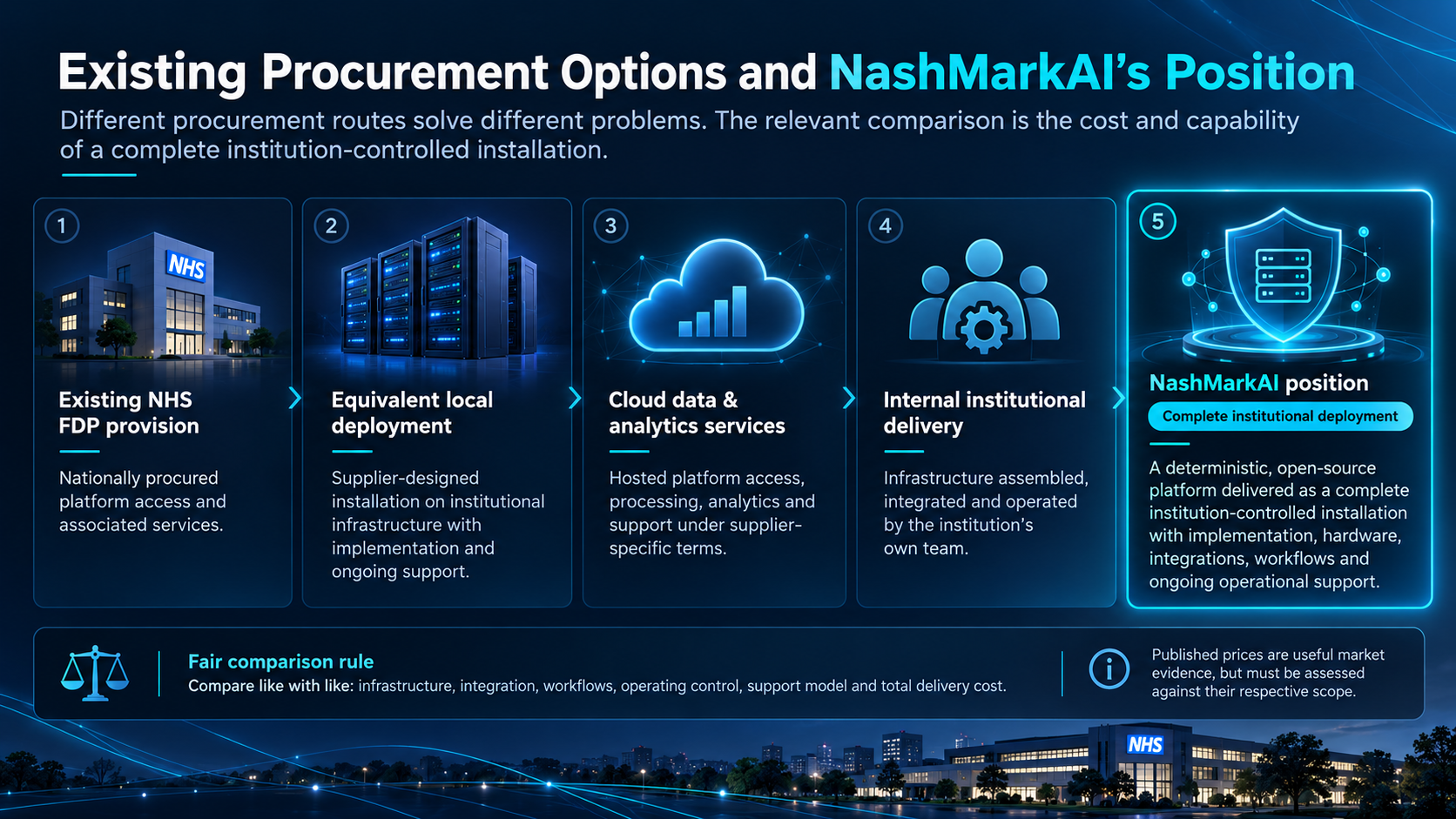
NashMarkAI’s NHS Sovereign FDP provides a deterministic, open-source data platform designed to operate within an institution’s own infrastructure. Its commercial proposition combines implementation with the supply and ongoing management of hardware, databases, Apache services, integrations and operational workflows.
The relevant comparison is the cost and capability of that complete institutional installation. A cloud analytics subscription, an integration project and a locally operated FDP cover different requirements. Their prices provide useful market evidence, but must be assessed against their respective scope.
2.1 The Procurement Alternatives
| Procurement option | What the institution purchases | Basis for comparison with NashMarkAI |
|---|---|---|
| Existing NHS FDP provision | Access to the nationally procured platform and associated services. | The operational workflows to be replaced, integration requirements, institutional control, continuing dependencies and transition costs. National contract expenditure is not an individual hospital quotation. |
| An equivalent locally deployed system | A supplier-designed installation operating on institutional infrastructure, with implementation and ongoing support. | Hardware, database and application services, functionality, source-code access, administration rights, support obligations and supplier exit. This is the closest direct procurement comparison. |
| Cloud data and analytics services | Hosted platform access, processing, analytics and associated support under supplier-specific terms. | Relevant functionality and service expenditure, accounting for differences in hosting, capacity, access and operating control. These are adjacent alternatives rather than equivalent local deployments. |
| Internal institutional delivery | Hardware and software assembled, integrated and operated by the institution’s own team, with external expertise where required. | Staff capacity, implementation time, infrastructure expenditure, documentation, monitoring and continuing operational responsibility. |
A direct supplier comparison requires an equivalent specification. This proposal does not yet identify a priced competing offer covering the complete NashMarkAI reference deployment.
2.2 Published Prices for Adjacent Services
Published procurement prices demonstrate the existing market for integration, platform provision and operational support. They provide benchmarks for individual elements of the NashMarkAI offer.
| Supplier and source | Published pricing | Relevance and limits |
|---|---|---|
| Hunter Healthcare — NHS Data Integration and Analytics Service, G-Cloud 15 pricing | System-wide integration and warehouse implementation: £85,000–£220,000. Acute, community and mental health integration: £50,000–£130,000. Cloud warehouse build and optimisation: £65,000–£150,000. | Establishes reference prices for scoped implementation and integration work. These packages should not be added together without establishing their scope and overlap. They are not a quotation for the complete five-year NashMarkAI installation. |
| Carnall Farrar — Integrated Data Platform, G-Cloud 14 listing | £50,000–£99,000 per licence annually. | A public-cloud analytics service with hosting, processing and regular refresh within its core support package. The listing restricts access to underlying data structures and patient-identifiable or row-level data. Some extraction services may attract additional charges. |
| CACI — Health Informatics Cloud, G-Cloud 15 pricing | Base platform: £10,834 annually. Developer platform: £33,668 annually. Implementation resources: £630–£1,181 per person per day, excluding VAT. | Published platform configurations include 1.5 TB storage and five reporting users. Implementation is separately priced. These configurations cannot be treated as equivalent to the capacity and scope of the NashMarkAI hospital model. |
Sources checked on 22 October 2026. The Hunter and CACI hosted pricing filenames are dated 29 January 2026; the Carnall Farrar listing does not display a publication date. Hunter Healthcare G-Cloud 15 pricing document
2.3 NashMarkAI’s Commercial Advantage
NashMarkAI brings the software, deployment method and operational service together around institutional control. The proposed installation gives the customer an openly licensed implementation running on its own infrastructure, supported through separately priced professional services.
| NashMarkAI provision | Institutional value | Commercial revenue |
|---|---|---|
| Local hardware and database environment | Direct control over infrastructure, capacity and administration. | Hardware supply, installation, monitoring, maintenance and replacement. |
| Open-source FDP implementation | Access to the implementation and the ability to appoint another suitably qualified service provider. | Deployment, configuration, integration and training. |
| Deterministic operational workflows | Defined rules and auditable processing without requiring generative AI for core FDP functions. | Workflow implementation, testing and commissioned extensions. |
| Documented operation and handover | Continuing operating capability and a practical basis for supplier transition. | Documentation, knowledge transfer and transition assistance. |
| Ongoing infrastructure services | Coordinated management of hardware, databases, Apache services, backups and the FDP environment. | Recurring maintenance, monitoring and agreed SLA services. |
| Additional local applications and capacity | Expansion according to institutional requirements. | Consultancy, further integrations, edge hardware and approved application deployments. |
The commercial opportunity rests on delivering and maintaining this capability effectively. Open-source software removes proprietary licence charges from the core offer while leaving substantial paid work in implementation, infrastructure and continuing service provision.
2.4 Establishing the Economic Comparison
The five-year reference deployment later in this proposal models £925,000 in customer contract revenue, £676,000 in direct delivery costs and £249,000 in contribution before central overheads. Including the modelled institution-side expenditure produces a customer total cost of £1.045 million. These are planning assumptions to be tested through the reference deployment.
An equivalent alternative must be costed against the same record volumes, integrations, workflows, user capacity, availability requirements and support coverage. The comparison must also include migration, hardware renewal, internal staffing and eventual handover or exit.
NashMarkAI’s investment proposition is a repeatable infrastructure business built around institutional control, paid delivery expertise and recurring operational services. The reference deployment will establish its measured delivery cost and margin, providing the evidence required to demonstrate any financial advantage over an equivalent alternative.
Proposal section
3. What NashMarkAI brings to that market
NashMarkAI’s proposed distinction is the combination of an inspectable implementation, institutional infrastructure and a documented route for operational continuity when suppliers change.
| Customer requirement | NashMarkAI proposition | Commercial significance |
|---|---|---|
| Institutional control | FDP and database deployed within the institution’s controlled environment | The customer retains its operating installation and determines who administers it. |
| Inspectable software | Open-source implementation and documented configuration | The institution can inspect, adapt and commission maintenance of the system. |
| Deterministic operation | Defined rules and workflows for the FDP’s operational functions | Core operation does not require a generative model or associated inference service. |
| Supplier portability | Asset inventories, export procedures, parallel running and reconciliation | Transition can be planned and tested against explicit records and acceptance criteria. |
| Reusable infrastructure | Hardware, database and application services form a continuing institutional resource | Further approved workloads can be added according to available capacity. |
| Accountable maintenance | Paid monitoring, administration, hardware cover and service agreements | The customer purchases defined operational responsibilities. |
The supplied FDP assessment reports that the reference implementation’s 100 embedded files matched their hashes and that its 12 tests passed. It identifies the dependency inventory, reconciliation procedures and supplier-exit evidence as particularly valuable elements. It also distinguishes this evidence from production load testing, live NHS integration and completed assurance. See Independent Evidence and Limitations.
This gives the business an existing technical foundation and an initial consultancy offering helping institutions understand dependencies, prepare data transitions and establish evidence for migration.